Jalisco & Costa Rica
Costa Rica is widely recognized as an environmental benchmark in Latin America. Its conservation model, clean energy policies, and community-based forest management have been studied by institutions such as the IUCN and UNEP. However, when comparing its territorial scale with that of Mexico, an important question emerges: could Jalisco build a similar—and perhaps even more innovative—model based on its own natural wealth?
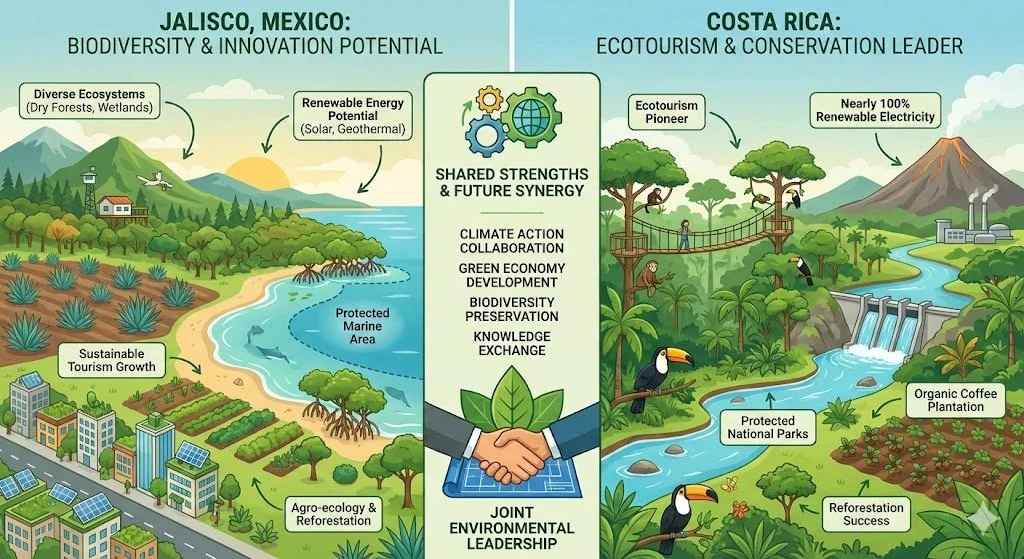
While Costa Rica contains extraordinary biodiversity within 51,100 km², Jalisco spans 78,600 km² and hosts a remarkable range of ecosystems, including mangroves, tropical dry forests, temperate pine-oak forests, mountain systems, and highly productive marine-coastal zones. Mexico is among the world’s megadiverse countries, and Jalisco is one of its ecological strongholds. On water management, both territories face significant pressures: Costa Rica due to increasingly extreme climate events, and Jalisco due to overexploited watersheds, pollution, and unsustainable extraction. These challenges make Jalisco a strategic place to develop innovative watershed-based solutions, including community water governance, rainwater harvesting, ecological restoration, and circular systems for water use. Institutions such as CONAFOR, SADER, and FONNOR are already advancing reforestation programs, integrated watershed management, and more responsible agricultural practices that help pave the way. Conservation also presents a clear opportunity. Costa Rica protects 26% of its territory, while Jalisco protects about 13%. Rather than a disadvantage, this gap represents a chance to design modern, participatory protected-area systems aligned with the state’s community and ecological realities—an approach supported by recent studies from CONABIO and the IUCN. In terms of circular economy and responsible land management, Jalisco has notable advantages: a diversified economy, an active entrepreneurial landscape, and growing private-sector interest in sustainability.
Costa Rica has demonstrated that conservation can transform a nation’s future. Jalisco—with its larger territory, exceptional ecological diversity, and a growing network of committed local actors—has the potential to become Mexico’s next environmental leader. At Sierra A Mar, we work every day to help accelerate that future—through community-based action, ecological restoration, and strong institutional collaboration. Our vision is clear: a Jalisco that conserves, regenerates, and inspires the entire country.
